The Linux Logo
The Linux logo is the Tux the penguin, a cartoon bird that Linus Torvalds chose in 1996 after a penguin bit him on the thigh at the Australian National Antarctic Research Establishment.
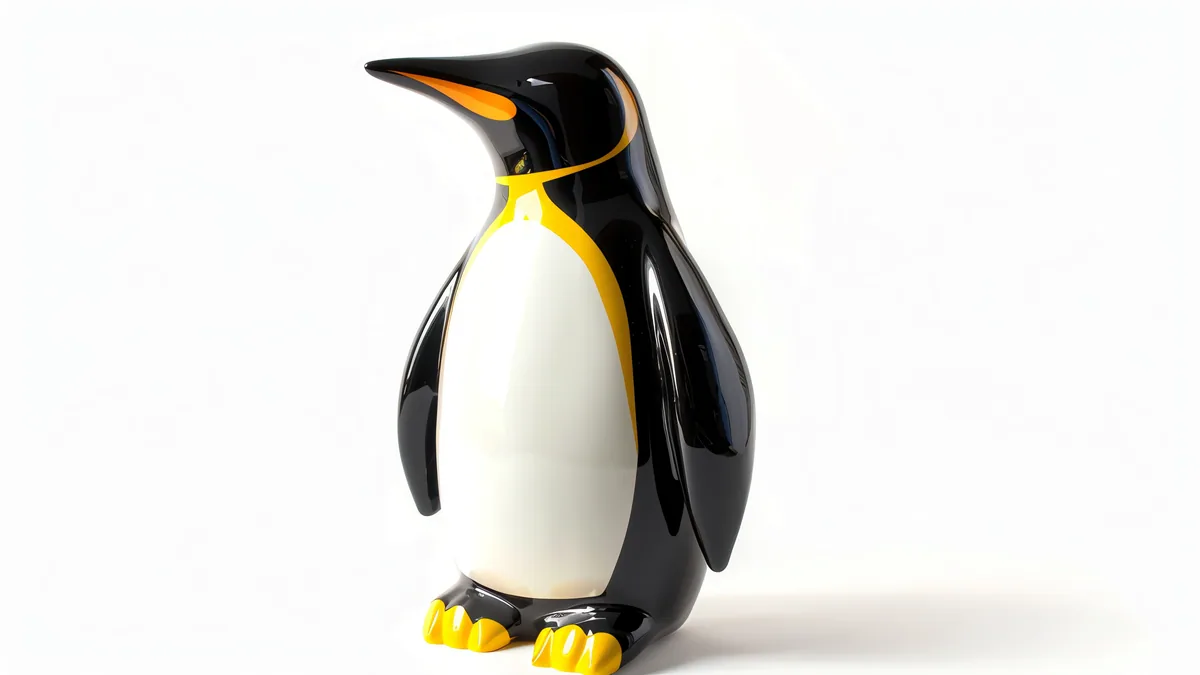
That one bite became the most recognisable symbol in open source, the mark that sits on the kernel logo, the server boot screen, and the millions of Tux figures in convention halls and on merch worldwide. This page follows that origin and then treats the icon the way an operator meets it, as a shipped asset inside the kernel source tree.
Start where the mark lives. The kernel repository is a git archive whose history stretches back to 1991, and the Tux files sit in it as source, not as decoration. Inside the Linux Kernel tree, the artwork ships under Documentation/, and the canonical vector files are Documentation/Logo/tux.svg and Documentation/Logo/redhat.svg, with a companion PNG for contexts that cannot render SVG. A git log on that path shows the artwork being maintained for decades, which is why the logo in a 2026 kernel release is the same penguin Linus sketched in 1996. When you pull the source and want to see the history, one command is enough. Run git log -- Documentation/Logo/tux.svg in the checkout, and the commit trail for the mark scrolls past you.
Why the penguin: the bite story
The penguin exists because of a single cold-day incident, and the story Linus told at the 1996 Linux Kongress in Adelaide is the account everyone repeats. He had visited the Australian National Antarctic Research Establishment, where staff carry penguins on their shoulders as a test of character, and a bird bit him on the thigh. He came home, drew a penguin, and the community adopted it. The name Tux arrived next. It is a play on the bird's tuxedo black and white, and it also matches the Linux project's naming habit: the kernel itself is a pun on Linus and Unix, so a cartoon bird that is also a nickname for the operating system fits the family. The origin is a person, a place, and a date, not a marketing decision.
How the Tux icon became the official logo
Adoption happened in three moves, and each one is verifiable rather than anecdotal. First, Linus sketched the design in 1996 and the community started using it as the project mascot. Second, the artwork was committed into the kernel source tree as an official asset, so it travelled with every release. Third, distributions, hardware vendors, and the project's own web presence standardised on the same Tux, which is why the penguin is consistent from a Raspberry Pi boot screen to a data-centre sign. Because the image lives in the source, the "official logo" is literally the file in the repository, and anyone can check the exact pixels by cloning the tree. That is the difference between a mascot that is only a brand and a mascot that is shipped code.
Where the Linux logo and the Tux icon appear
The Tux icon shows up in four distinct places, and the list helps a new operator know what they are actually looking at. The kernel logo is the small Tux on documentation and release pages. The boot splash is the penguin that appears on the console during early boot. The distribution branding is a recoloured or re-cropped Tux carried by a distro, such as the red-hat mark derived from the same family. And the merchandise is the figurine and sticker economy built around the character. A single asset, four surfaces, which is why the design is kept simple enough to read at both 24 pixels in a status bar and two metres on a conference backdrop.
- The kernel logo in the Documentation/Logo/ path of the source tree
- The boot splash on the console during early boot
- Distribution branding that recrops the same Tux
- Merchandise, stickers, and figurines sold at events
Tux versus other operating system symbols
Operating systems usually carry a symbol that encodes something about their identity, and comparing Tux to its neighbours makes clear why the penguin reads the way it does. The table below lines up three marks against the story each one tells and the asset that carries it.
| System | Symbol | What the mark encodes | Where the asset ships | |
|---|---|---|---|---|
| Linux | Tux the penguin | A founder's personal story, 1996 | Documentation/Logo/tux.svg in the kernel tree | |
| Windows | Four-panel window | The desktop grid, a product decision | Windows shell and boot assets | |
| macOS | Apple fruit | The company name and founder's story | Apple system assets |
The pattern is that a mark encodes either a person or a product decision, and Tux is the person case. That is also why it survives: a founder's story ages better than a product decision that gets redesigned with every release cycle.
Using Tux in a Linux project: the practical side
Treating the penguin as a shipped asset means you handle it with the same tools you handle any file in a checkout, and that is where the icon story meets daily work. If you need to confirm the mark in a local clone, navigate to Documentation/Logo/ and open tux.svg or the PNG fallback. If you are debugging why a splash image is missing on a minimal build, the asset is usually dropped from the build rather than absent from the source, so a search of the tree confirms it exists. The same file-hunting skill applies to the rest of the stack. When you Learn Linux Commands for the first time, locating files is the first habit to build, and the path to the logo is a safe place to practise it. A command like find Documentation -name "tux*" in the checkout returns the asset and teaches the flag you will reuse everywhere. That habit transfers to the server side too, because the same find, grep, and ls muscle you build while tracking down an icon is the muscle you run when a service misbehaves. If you are standing up a stack where PHP talks to Apache in front of MySQL, the icon is not the point but the file discipline is, and that discipline is what Linux for the LAMP stack relies on in every production box. And when a deployed build is missing a file you expected, the fastest path is to ask where the file lives before you ask why it vanished, so a short drill in how to Find Files on Linux saves a long rebuild. The penguin is the story; the file tree is the skill, and the two are the same lesson.
Reading the file history
The git history of the logo is a short, clean record, and reading it teaches how to read any asset's lineage. A git log --follow -- Documentation/Logo/tux.svg traces renames, and a git blame on the current file shows who last touched the paths. The record confirms what the story says: a 1996 origin, a steady hand of maintainers, and a mark that has changed little because it had to stay a penguin. That stability is the whole point of a logo that is also code.